History of St. Joseph Church
-
-
A History of the Parish of St. Joseph in Covington, Indiana
It is good for us to remember our past so we can appreciate our present and keep alive the future of our small Church.
St. Joseph is the oldest church structure in Covington AND the oldest still functioning church structure in our Lafayette diocese of 61 parishes. We have a very typical beginning for a Catholic Church. We were a church started by immigrants. Most Catholic Churches in the United States were erected by those who dared to leave their homeland. When they crossed they ocean, the faith that they knew and adored wasn’t here. So, they took the initiative and set out to build their own.
In the 1850’s the Wabash and Erie Canal was well underway. The canal was a shipping canal that connected the Great Lakes to the Ohio River. On February 22, 1832 ground was broken to begin construction. It reached Logansport in 1837, and Terre Haute in 1848, and Evansville in 1853. The canal ended in 1887 after it was no longer economically viable. The canal brought workers from everywhere, but particularly from Ireland.
Railroads were becoming a more reliable and cost effective way of transportation so along came railroad workers. A railroad builder named Mr. James S. McMahan was very important our Church. Some of you may member some ladies by the name of Josephine Royal and Ann Scheurich? Mr. McMahan was their relative.
Mr. James McMahan was a railroad construction foreman. In 1859, many were talking about the need for a Catholic Church in the area. Father O’Flaherty was in charge of the circuits of Montgomery, Fountain and Warren Counties prior to 1859. Catholics were having Masses whenever Father O’Flaherty came around about once a month. They sometimes met in people’s homes, community halls and even the Courthouse. There were about 60 families, around 350 people at that time.
Father Francis Joseph Stephan and Father Joseph Rademacher were the priests assigned to help initiate St. Joseph church being built. In 1861 and Dr. S.J. Weldon donated 3 lots that the church is on. Mr. McMahan oversaw the construction.
Bishop Leurs came to dedicate St. Joseph in 1867. It took 6 long years to build. Construction had to stop because of the Civil War that took many men, money and materials. Building resumed again in 1865. The Church cost $6,000 to build.
Father Stephans was the first resident priest. The population in Stringtown and Coal Creek was booming because of the new coal mines and expansion of the railroads. Lots of immigrants were going down there to work. Stringtown had around 2500 people. Father Stephans helped with the missions in Stringtown and Coal Creek.
St. Joseph once had a glorious steeple that could be seen for miles but had to be taken down by 16 feet because it was too heavy and causing structural damage.
The outside walls were covered with cement coating. A frame structure was built in 1875 at the back of the church and was used for a time as a school. There was a fire, the structure was repaired, but the school was no more.
There once stood a rectory where Vernon hall is today. Now we have a pre-fabricated home that was placed in 1946. Some parishioners called it “Cracker box home” and predicted it would not last 10 years.
In 1964, Fr. Peter Crelly had said “we will be finding ourselves in the basement during Mass” so a new floor was put in because of termite damage. Mass was held in the courthouse during that time.
Vernon hall, the building next to the church, was built in 1969. In 1972, a new soundproof confessional was installed to quiet the complaints that “anyone in church could hear confessions clearer than the priest.”
From 1995-2000, ‘the hall that bingo built’ was erected and is now our St. Joseph Parish Hall. Vernon Hall is now classrooms.
Some fun facts about St. Joseph:
- On October 8, 1949 Dr. T.T. Suzuki delivered a newborn parishioner Louis Frazer in the rectory. Although he was a native Japanese-American, Dr. Suzuki was not allowed to practice in local hospitals because of post World War 2 prejudice.
- The cost of the church was $6000 that would be about
- $114,000 today.
- Veedersburg also had a mission Church we oversaw called St. Mary's.
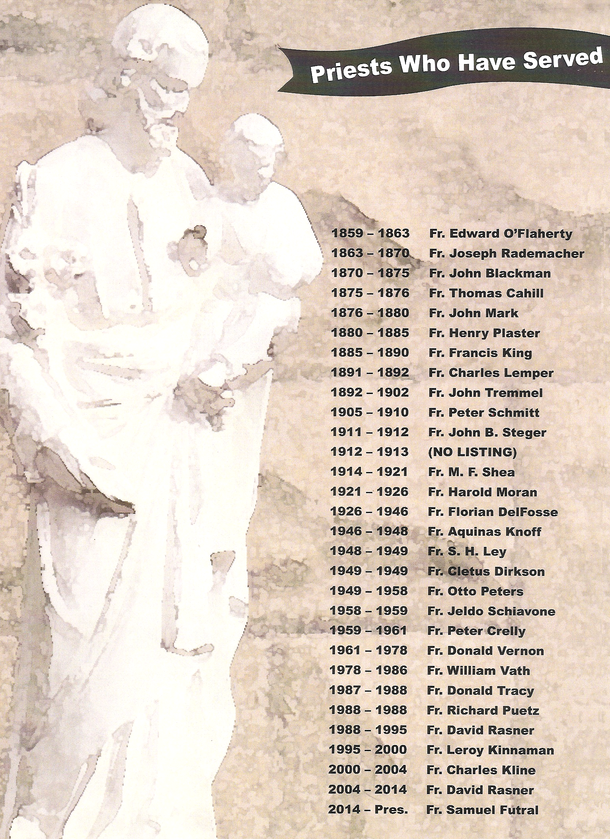
- 28 priests have come and gone in our 160 years since we were established in 1859.
We think St. Joseph, the carpenter, would be proud of the construction of our church and how it has been kept up over all these years. May he continue to watch over us and pray for us.
-